Freedom From Glasses and Contacts Starts Here
Las Vegas & Henderson’s Most Trusted LASIK Surgeons – 95% Success Rate
Imagine waking up each morning with crystal-clear vision. No more searching for glasses, no more contact lens hassles, no more limitations on your active Las Vegas lifestyle. Our award-winning team of fellowship-trained surgeons has helped thousands of patients achieve visual freedom with the safest, most advanced LASIK technology available.
- 95% Single-Treatment Success Rate
- 5 Convenient Las Vegas Valley Locations
- Same-Day Consultations Available
Why Las Vegas Trusts Shepherd Eye Center for LASIK
Unmatched Surgical Expertise
Our team includes multiple board-certified, fellowship-trained ophthalmologists with thousands of successful LASIK procedures. Led by Dr. John R. Shepherd, our surgeons combine decades of experience with the latest surgical innovations.
Advanced Technology, Better Results
- Blade-Free LASIK: Precision flap creation for enhanced safety
- Wavefront Technology: Custom treatment for your unique vision
- All-Laser Surface Ablation (PRK): Alternative option for optimal candidates
Comprehensive Care Beyond LASIK
Unlike single-service laser centers, we’re your complete eye care team. From your initial consultation through years of follow-up care, we’re here for every aspect of your vision health.
Proven Track Record
- 95% single-treatment success rate
- Thousands of satisfied patients
- 30+ years serving Las Vegas
- 5 convenient locations
“It’s clear that the team at Shepard Eye Center truly cares about their patients. I left feeling well taken care of and with a much better understanding of my eye health.” – Gerry A, Shepherd Eye Patient
How Successful is LASIK?
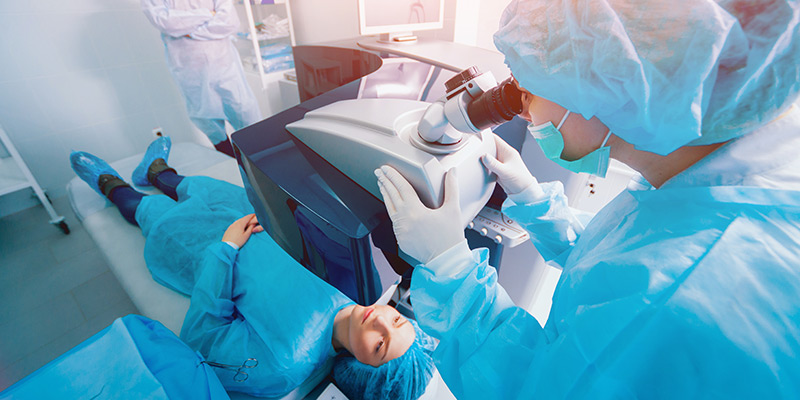
The majority of patients who undergo LASIK are able to see 20/40 or better right away and are able to pass the driver’s license test without glasses or contact lenses. Because some people treated have high degrees of correction and/or astigmatism, it is occasionally necessary to fine-tune or enhances the primary treatment to obtain the best final result. Statistically, each patient has about a 95% chance of only requiring a single treatment to achieve their desired visual outcome. Approximately, less than 5% return to the laser for enhancement of any residual astigmatism, or a slight over or under-correction. “Since having the surgery, I don’t have to worry about having my glasses slip down my nose while working out at the gym.”
How is LASIK Performed?
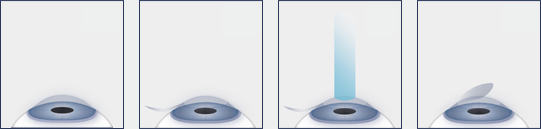
LASIK is a painless procedure performed in an outpatient setting with topical anesthesia. The eye drops are used to completely numb the eye but not the eyelids. The eyelids are held open with a small instrument to prevent blinking. The patient feels the sensation of the instruments around the lid area but does not feel any pain. A suction ring is placed on the eye and the patient feels a little pressure while the vision goes dim for a brief period of seconds. A microkeratome slides across the cornea in less than 15 seconds to create a thin lamellar corneal flap. After proper alignment, the high-energy pulses from the excimer laser are delivered to reshape the surface. By adjusting the pattern of the laser beam it is possible to treat myopia, hyperopia, and astigmatism. After the laser treatment has obtained the proper contour the corneal flap is replaced in its original position. A protective eye shield is placed over the eye and worn for the first 12 to 24 hours as well as when sleeping for the next 3 to 4 days. The cornea has rapid healing qualities and no sutures are needed. However, fluctuation in vision and intermittent dry eyes is not uncommon for the first several weeks and months. Postoperative recovery is quick and easy. Most patients feel minimal to no eye irritation during the first two hours and many patients see a dramatic improvement in vision by the first day. However, fluctuation in vision and intermittent dry eyes are not uncommon for the first several weeks.
Am I a Good LASIK Candidate?

Most people are surprised to learn they’re excellent LASIK candidates. If you’re tired of glasses or contacts interfering with your lifestyle, you’re likely a great fit for life-changing LASIK surgery.
Ideal LASIK candidates typically:
- Are 18 years or older with stable vision
- Have healthy eyes free from disease
- Want freedom from glasses and contacts
- Lead active lifestyles (sports, swimming, travel)
- Work in demanding environments (hospitality, entertainment, outdoor professions)
Not sure if you qualify? Our comprehensive evaluation will determine your best vision correction option. Even if traditional LASIK isn’t right for you, we offer alternatives like EVO ICL, PRK, and Clear Lens Exchange.
Contact Us Today for Your Consultation>
The Las Vegas Advantage
Las Vegas residents choose LASIK for:
- Pool and beach activities without contact lens concerns
- Active outdoor lifestyle in our year-round sunshine
- Professional demands in hospitality and entertainment industries
- Freedom from glasses fogging in air-conditioned environments
Who is a Good Candidate for LASIK?
To determine if you are a good candidate, a thorough eye exam should be performed. In general, an ideal candidate is over the age of 18, with stable refraction and healthy corneas. People with eye diseases like keratoconus, cataracts and some types of glaucoma, as well as patients with certain medical conditions and women who are pregnant, may not be good candidates. However, patients who may not be good candidates for LASIK may benefit from other refractive procedures like clear lens replacement and implantable contact lenses (ICL).
Realistic expectations are also important to determine if you are a good candidate. The decision to have laser vision correction must be made based on facts, not hopes and misconceptions. The goal with Laser Vision Correction is to reduce your dependency on contact lenses or glasses. In the majority of cases, good useful vision is obtained with a single treatment or with an enhancement. Therefore, a patient under the age of 40 often performs all activities without glasses. Unfortunately, LASIK cannot correct a condition known as “presbyopia.” This condition affects everyone around the age of 40 causing a decrease in the ability to see or read up close without glasses. Therefore, if a patient’s vision is improved for the distance they may find an increased dependency on glasses for near work or reading. Leaving a little nearsightedness in one eye can help this condition. This technique is called monovision. It is important to discuss all of these options with your doctor.
What Can I Expect After LASIK?
Many patients are somewhat nervous before the procedure so a sedative to alleviate anxiety is given. This also relaxes you so that you are able to go right home and go to sleep, at least for a few hours. Don’t expect your vision to be clear on the first day. It’s somewhat like looking underwater. Since the flap is repositioned by floating back into place, a minor amount of swelling occurs. Plus, we protect your eyes with plastic shields which can also blur your vision. But, after a good night’s rest, most patients are ecstatic with their new vision. You must then use antibiotic drops and mild steroid drops for the next few days and lubricating drops as needed for the dry eye feeling.
LASIK Investment & Financing Options
What Does LASIK Cost?
LASIK is one of the most cost-effective investments you’ll ever make. When you calculate the lifetime cost of glasses and contacts, most patients discover LASIK pays for itself within 2-3 years.
Consider these ongoing costs:
- Annual eye exams: $200+
- Prescription glasses: $400-800+ every few years
- Contact lenses and solutions: $300-600+ annually
- Sunglasses prescriptions: $200-500+
Flexible Financing Available
We believe financial concerns shouldn’t prevent you from achieving visual freedom. That’s why we offer:
- 0% interest financing for qualified patients
- Flexible monthly payment plans
- HSA and FSA accepted
- Multiple insurance options
Most patients pay less per month for LASIK than they currently spend on contacts!
Contact Us Today to Learn About Your Financing Options >
What About Dry Eyes After LASIK?
Dry eye symptoms are the most common complaint after LASIK. Everyone has dry eyes after surgery, but some notice it more than others. In this type of laser vision correction, a thin corneal flap is created on the surface of the eye. When the flap is made, the abundant supply of corneal nerves is also cut. This results in a partially anesthetized corneal surface. It requires 3-6 months for these nerves to re-grow and provide the cornea normal sensation. As a result, the normal tear production is also interrupted and everyone experiences some degree of dryness, especially the first 2-4 weeks. There are numerous artificial tears and lubricating drops available as over-the-counter products. We initially recommend the preservative-free products to prevent any unnecessary toxic response. But, as your eyes improve, switching to the more convenient bottles of preserved products is allowed. If the frequent use (at least every hour) of artificial tears does not improve your symptoms, then temporary or permanent closure of a tear duct can provide added relief. Since this is a temporary condition (3-6 months) in most cases, many patients do extremely well by simply lubricating their eyes with artificial tears. Restasis, a new prescription drop for the treatment of Dry Eye, is useful in select patients.
How Do I Know if I Need an Enhancement?
The schedule of routine post-op visits includes a one day, one month and 3-month visit. Since the vision may fluctuate as the cornea heals, we recommend waiting a minimum of 3 months to reevaluate your visual results.
When we reevaluate, we look at such things as your vision without glasses and your prescription where we measure any residual astigmatism or mild over or under correction. We ask about your nighttime driving and your reading vision. If your vision is not as good as you think it should be, and if there is a minor residual correction that can be treated with the laser, then an enhancement is discussed. Enhancement surgery is actually easier than the initial procedure because a flap is already present. In most cases, the surgeon simply identifies the edge and lifts up the original flap without cutting a new one. Because the cornea heals this layer very slowly, it can easily be lifted up to 1-2 years after surgery. In some instances, surface ablation is required and your surgeon can explain why it might be best in your particular situation. However, the healing process is the same and requires another 3 months to determine the final result. With a little patience and plenty of artificial tears, the surgeons at Shepherd Eye Center in Henderson and Las Vegas will do everything in their power to help obtain the best, most functional vision possible. Our bottom-line is quality vision and your satisfaction.